
About one in three people who use a food bank in Canada is a child – roughly 712,000 visits a month in 2025. Food bank use has nearly doubled since 2019. Youth hunger in Canada is not a fringe problem; it is measurable, national, and growing. Here is the data, what is driving it, and where help actually comes from.
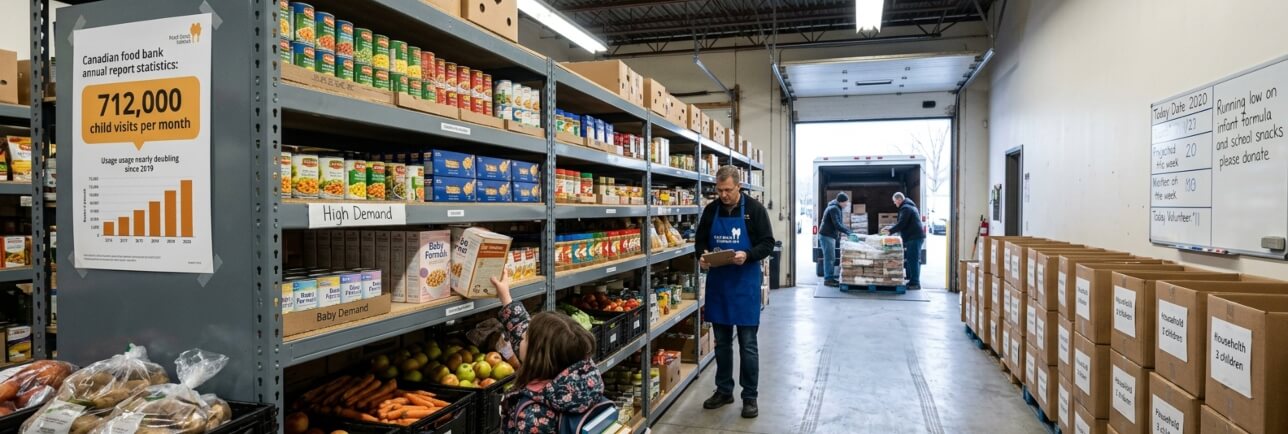
Essential facts and figures
Food bank use in Canada hit record highs three years running. The clearest measure comes from Food Banks Canada’s annual HungerCount, a census of food banks taken every March.
Measure | March 2019 | March 2024 | March 2025 |
|---|---|---|---|
Total monthly visits | ~1.08 million | 2,059,636 | ~2,166,000 |
Change vs. 2019 | – | +90% | ~doubled |
Children’s share of visits | – | 33% (~700,000) | 33% (~712,000) |
Clients who are employed | 12% | 18% | 18% |
Source: Food Banks Canada, HungerCount 2024 & 2025.
Who is affected
Children carry a disproportionate share. Kids under 18 make up about a third of all food bank visits while being a smaller share of the population. The face of food insecurity has also shifted toward working and two-parent households.
- Children under 18: about 33% of visits – close to 712,000 a month in 2025.
- Two-parent households with kids: up from 18.8% of food bank households in 2019 to 23% in 2025.
- Employed clients: nearly 1 in 5 (18%) have a job – up from 1 in 10 in 2019.
- The PM’s office stated in 2024 that nearly one in four Canadian children does not get enough food.
Food bank use by region
The strain is national but uneven. Some provinces and the territories have seen the sharpest recent jumps.
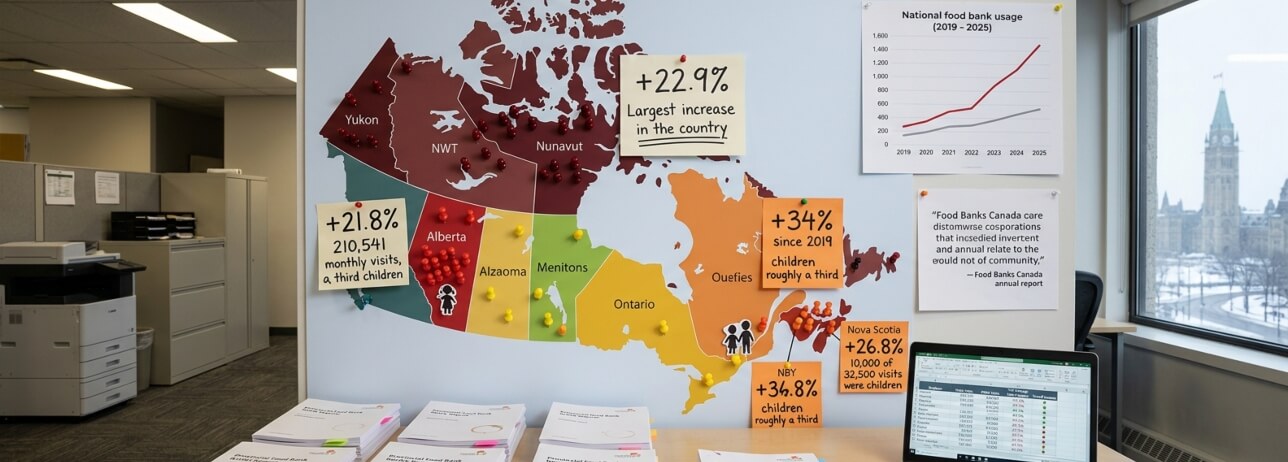
Region | Recent change | Note |
|---|---|---|
Alberta | +21.8% (2024→2025) | ~210,541 monthly visits in 2025; a third were children |
The territories | +22.9% (2024→2025) | Largest year-over-year increase in the country |
New Brunswick | +34% (2019→2023) | Children were roughly a third of visits |
Nova Scotia | +26.8% (2019→2023) | About 10,000 of 32,500 visits were children |
Why it is getting worse
The main driver is the squeeze between housing and food costs. Food Banks Canada calls it a one-two punch: rent and grocery inflation hit low-income households faster than wages or social assistance can keep up. The system is straining – close to 30% of food banks reported running out of food during the 2024 count.
What “food insecurity” actually means
Food insecurity is a spectrum, which is why a working family can be food insecure without ever visiting a food bank. Statistics Canada and researchers use three tiers:
Level | What it looks like |
|---|---|
Marginal | Worry about running out of food; limited choice. |
Moderate | Compromising on the quality or quantity of food eaten. |
Severe | Missing meals, reducing intake, going days without eating. |
Myths and facts
Myth | Fact |
|---|---|
Hungry families are unemployed. | Nearly 1 in 5 food bank clients are employed. |
Food drives are the best way to help. | Money lets charities buy in bulk and stretch each dollar much further. |
This is a big-city problem. | Rural areas and the territories have seen some of the fastest growth. |
It only affects a small minority of kids. | Children make up about a third of all food bank visits. |
How help reaches kids
No single channel solves youth hunger – it takes three working together, each reaching kids at a different point.
Channel | How it works | Example |
|---|---|---|
Food banks | Emergency groceries for families, often with kid-specific programs | Greater Vancouver Food Bank, Daily Bread (Toronto) |
School meal programs | Breakfast or lunch served at school, no stigma, no cost | Breakfast Club of Canada |
Food rescue | Redirects surplus edible food to charities serving youth | Second Harvest |
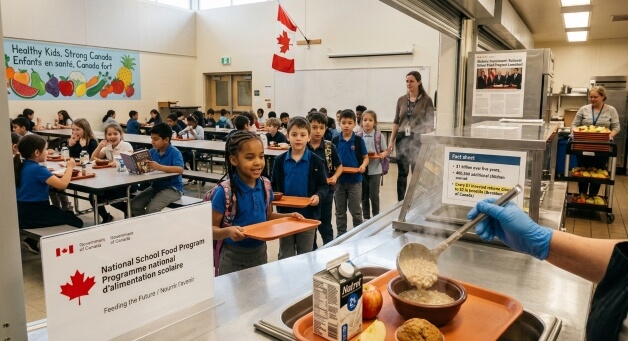
The National School Food Program
Canada now has its first national school food program – a major shift announced in 2024. Until then, Canada was the only G7 country without one. Budget 2024 committed $1 billion over five years, the program launched in the 2024-25 school year, and it was made permanent in 2025. The target: nutritious meals for up to 400,000 more kids a year, on top of the roughly 2 million already served by local programs. Source: Government of Canada.
School meals also pay off economically. A study commissioned by the Breakfast Club of Canada found that every $1 invested in school breakfast programs generates close to $2 in economic and social benefits.
What works: evidence-based ways to help
- Universal school meals – remove stigma and reach every kid, not just those who self-identify.
- Income supports – food insecurity tracks income; benefits like the Canada Child Benefit move the numbers.
- Food rescue – redirecting surplus food cuts waste and feeds people at low marginal cost.
- Steady funding for charities – reliable money beats one-off drives for planning and bulk buying.
Organizations doing the work
If you want your money or time to reach kids, these national organizations are the most direct routes. All are registered Canadian charities.
- Food Banks Canada – national network of 5,500+ food banks and community programs (foodbankscanada.ca).
- Breakfast Club of Canada – school breakfast programs reaching schools nationwide (breakfastclubcanada.org).
- Second Harvest – Canada’s largest food-rescue organization (secondharvest.ca).
- BB4CK / Feeding Futures – lunches for Calgary kids; carries on the former Mealshare model (bb4ck.org).
How to help
The three highest-leverage actions are donating, volunteering, and advocating – in that order of immediate impact.
- Donate money, not just food. Charities buy in bulk and stretch a dollar much further than a can of soup.
- Volunteer. Meal prep, packing, and delivery are where most organizations are short-handed.
- Advocate. Support school food programs and income supports – the policies that move the numbers.
- Vet before you give. Check a charity’s registration and independent ratings.
Where the data comes from
Figures on this page draw on Food Banks Canada’s HungerCount 2024 and 2025 reports, Statistics Canada food-insecurity definitions, and Government of Canada announcements on the National School Food Program. HungerCount counts visits in March each year, so figures reflect that month, not annual totals.
FAQ
Children account for about a third of food bank visits – roughly 712,000 monthly visits in 2025 – and the federal government has said nearly one in four Canadian children does not get enough food.
Close to it. Visits rose about 90% from 2019 to 2024 and reached roughly 2.17 million in March 2025 – nearly double the 2019 level.
Increasingly, yes. The National School Food Program, funded with $1 billion over five years from 2024-25, aims to reach up to 400,000 more kids a year.
Donate money to a registered charity, volunteer, and support school food and income policies. Money is usually the most efficient form of help.
About this page: this is an informational resource on youth hunger in Canada. We do not collect donations here – give directly to a registered charity.