
Mealshare was a Canadian social enterprise that ran from 2013 to 2023. The model was simple: order a menu item marked with the Mealshare logo at a partner restaurant, and the restaurant donated the cost of one meal to a youth-hunger charity – at no extra charge to you. By the time it wound down, partner charities reported the program had touched the lives of nearly 6 million young people.
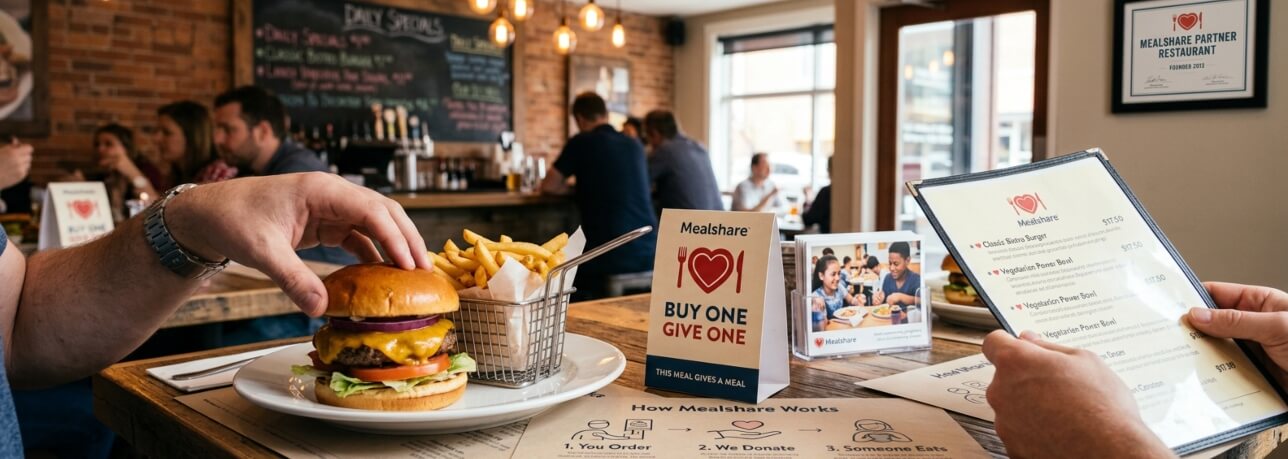
The model in 30 seconds
Two diners, one transaction, two meals. You bought a meal for yourself; a hungry young person got one too. Mealshare did not run shelters or kitchens itself – it was the bridge between restaurants and the charities already doing that work.
Detail | Summary |
|---|---|
Founded | 2013, Calgary, Alberta |
Founders | Jeremy Bryant and Andrew Hall |
Model | Buy one, give one – restaurants donated about $1 per Mealshare menu item ordered |
Reach at peak | Hundreds of partner restaurants in communities across Canada |
Where money went | Vetted local and international youth-hunger charities |
Closed | June 2023 |
Continues as | Feeding Futures, run by Brown Bagging for Calgary’s Kids (BB4CK) |
Timeline: from a Calgary idea to a national program
Year | Milestone |
|---|---|
2013 | Two friends in Calgary learn that millions dine out daily while over a million Canadian youth are food insecure. Mealshare launches. |
2014-2019 | Expansion to Toronto, Vancouver, Winnipeg and beyond; hundreds of restaurants join. |
2020 | Site counter passes 3.4 million meals served. COVID-19 closes dining rooms and chokes the donation funnel. |
2021 | A&W Canada partnership puts Mealshare in 1,000+ locations – the largest single expansion. |
June 2023 | Mealshare announces it will close after nearly a decade. |
2023-now | BB4CK carries the model forward in Calgary as Feeding Futures. |
How the buy one, give one model actually worked
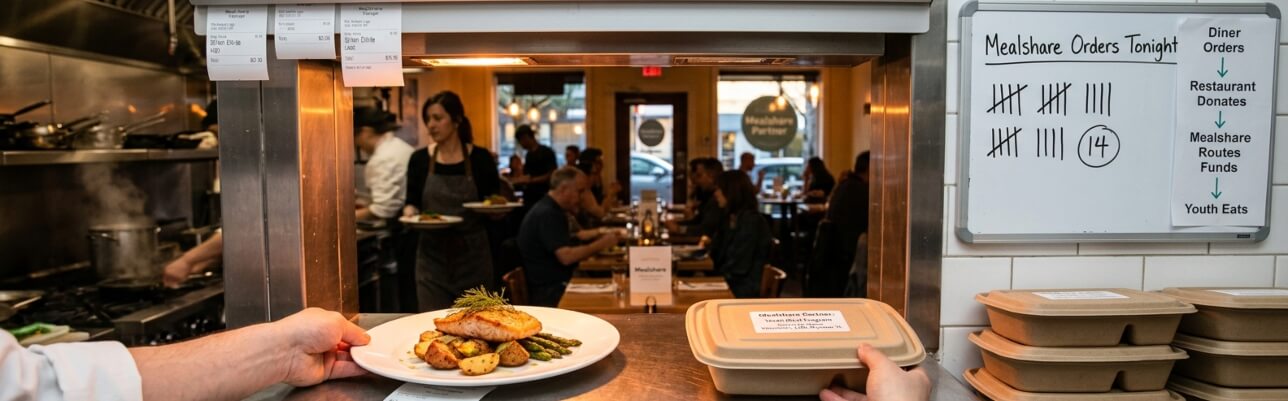
It worked because it asked almost nothing of the diner. No donation box, no rounding up, no separate payment. The point was to make giving invisible and automatic.
- Find a partner restaurant – look for the Mealshare logo on the door or beside menu items.
- Order a Mealshare item – a normal menu dish at the normal price, with no surcharge.
- The restaurant donated – for every Mealshare item sold, it set aside roughly the cost of one simple, healthy meal.
- Mealshare routed the funds – money went to charity partners who delivered actual meals to youth in need.
Player | Their part |
|---|---|
The diner | Chose a logo-marked dish. Paid the regular menu price. |
The restaurant | Contributed about $1 per item and tracked Mealshare sales. |
Mealshare | Collected and distributed funds, vetted charities, reported impact. |
The charity partner | Turned the money into real meals for young people. |
Why the model worked so well
Most charitable giving fails at the friction point: people mean to give but the ask comes at the wrong moment, or feels like a guilt tax. Mealshare removed the friction entirely.
- Zero added cost. The diner paid menu price, so there was no spending decision to second-guess.
- No awkward ask. The donation was built into a purchase people were already making.
- Built-in trust. Funds went to established charities, not to a stranger with a collection tin.
- A visible win for restaurants. The logo signalled values to customers and drove menu choices.
How Mealshare compared to other giving models
Mealshare sat in a sweet spot between effort and impact. Here is how the dine-out model compared with other common ways Canadians give to fight hunger.
Giving model | Effort for the giver | Trade-off |
|---|---|---|
Mealshare (buy one, give one) | None beyond ordering | Limited to partner restaurants |
Round-up at the till | One tap | Small amounts; can feel like pressure |
Direct charity donation | Moderate | Highest control and tax receipt |
Food drive (canned goods) | High | Sorting costs often exceed food value |
Where the money went
Funds flowed to established charities already feeding youth, not into Mealshare’s own programs. That partner model is why a small organization could claim national reach. Charity partners over the years included:
- Calgary Drop-In Centre – emergency shelter and meals in Calgary.
- Breakfast Club of Canada – school breakfast programs nationwide.
- The Stop Community Food Centre – food access and community meals in Toronto.
- Eva’s – services for homeless and at-risk youth in Toronto.
- Save the Children – international child nutrition programs.
The A&W partnership: the scale moment
In 2021, Mealshare announced a partnership with A&W Canada that put the program in more than 1,000 restaurant locations at once – the largest single expansion in the company’s history. It came at a hard time: restaurant closures during COVID-19 had cut deeply into the dine-in donations the model relied on. A&W gave the program a way to keep going when its core funnel had collapsed.
The numbers
Two figures tell the story, and they measure slightly different things, so it is worth being precise:
Figure | What it counts | Source / timing |
|---|---|---|
3,444,296 meals | Meals served, per the site’s live counter | Mealshare site, early 2020 snapshot |
~6 million young people | Youth the program is reported to have impacted | BB4CK, at the 2023 wind-down |
1,000+ locations | A&W restaurants added in one partnership | A&W Canada partnership, 2021 |
The two totals are not contradictory – one counts meals delivered, the other counts kids reached over the full life of the program.
Why Mealshare closed
Mealshare announced in June 2023 that it would close after nearly ten years. The pandemic hit the dine-out model hard: when restaurants shut their doors, the donation engine stalled while demand for youth food support rose. The closure mirrors a wider squeeze on Canadian food charities, many of which have struggled with rising costs and softer donations since 2020.
What continues today
The mission did not disappear with the brand. In Calgary, longtime partner Brown Bagging for Calgary’s Kids (BB4CK) committed to carrying the work forward through a program called Feeding Futures, which keeps the restaurant-and-charity model alive locally. Nationally, the organizations Mealshare once funded – like the Breakfast Club of Canada and Second Harvest – are still doing the day-to-day work of getting food to young people.
Lessons from Mealshare’s decade
- Frictionless beats heartfelt. The easiest ask wins more often than the most emotional one.
- Partner, don’t rebuild. Routing money to existing charities scaled faster than running programs in-house.
- Concentration is risk. A model tied to dine-in traffic was fragile when dining rooms closed.
- Legacy can outlive the brand. The model survives locally even though the organization did not.
FAQ
No. Mealshare closed in June 2023. Its Calgary legacy continues through BB4CK’s Feeding Futures program.
No. Mealshare items cost the same as any other dish. The restaurant, not the customer, made the donation.
Roughly the cost of one simple, healthy meal – about $1 per Mealshare item ordered, contributed by the restaurant.
Young people facing food insecurity, served through vetted charity partners across Canada and, in some cases, internationally.
Donate to or volunteer with an active registered charity such as Food Banks Canada, Breakfast Club of Canada, or Second Harvest.
About this page: Mealshare is no longer operating and is not collecting donations. This page is an informational record of how the program worked.