
Plenty of Canadian restaurants turn an ordinary order into a donation. The biggest are A&W’s Burgers to Beat MS, Tim Hortons’ Smile Cookie, and McDonald’s McHappy Day – together they raise tens of millions of dollars a year. Here is how the main give-back models work, which campaigns are worth knowing, and how to take part without spending a cent extra.
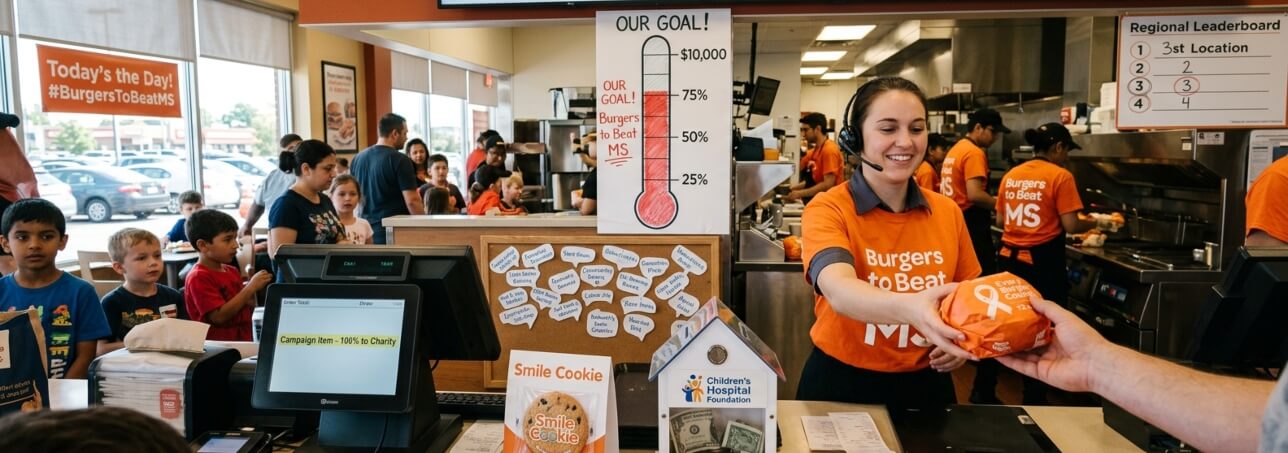
How “give-back” restaurants actually work
There is not one model – there are five, and they ask different things of you. Knowing which is which tells you exactly where your money goes.
Model | How it works | Your effort |
|---|---|---|
Cause-day item donation | On a set day, $X from a specific item goes to charity | Order that item on the day |
100% of proceeds product | Every cent from a product (e.g. a cookie) is donated | Buy the product |
Round-up at the till | Your total rounds up to the next dollar; the difference is donated | Say yes at checkout |
Buy one, give one | A marked item triggers a donated meal for someone in need | Order the marked item |
Foundation / % of sales | A chain’s foundation funds youth programs from ongoing sales | None – built into the brand |
The big Canadian campaigns worth knowing
Three national campaigns do most of the heavy lifting, and all three are easy to join. The figures below are the most recent reported totals.
Campaign | How it works | Who benefits | Recent total |
|---|---|---|---|
A&W Burgers to Beat MS | $2 per Teen Burger on the annual August day | MS Canada | $21.7M+ since 2008 |
Tim Hortons Smile Cookie | 100% of proceeds, one week (late Apr-May) | 600+ local charities & camps | $22.6M in 2025; $151M+ since 1996 |
McDonald’s McHappy Day | Portion of all sales for a day, plus year-round Round Up | Ronald McDonald House & kids’ charities | $11.3M in 2025; $111M+ all-time |
A&W – Burgers to Beat MS
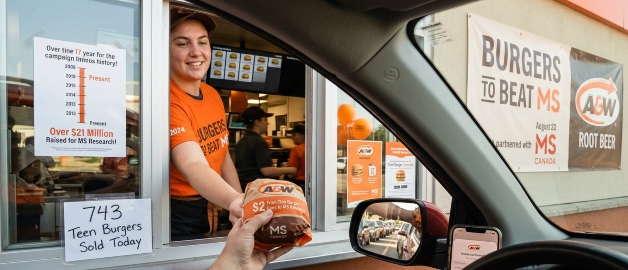
A&W has run Burgers to Beat MS every year since 2008. On the campaign day each August, $2 from every Teen Burger sold – dine-in, drive-thru, or app – goes to MS Canada. The 2025 edition was the 17th, and the campaign has raised more than $21.7 million to date.
Tim Hortons – Smile Cookie
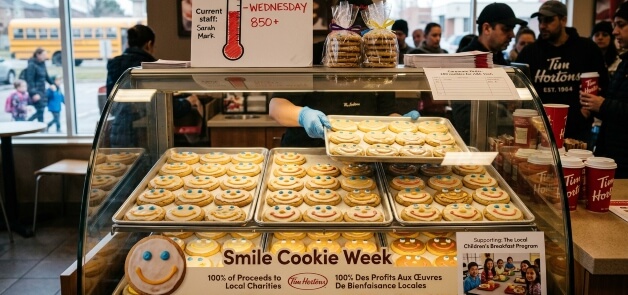
For one week each spring, 100% of the proceeds from every Smile Cookie go to local charities chosen by each restaurant’s owner. The 2025 campaign set a record at $22.6 million across 600+ charities, hospitals, and community groups; since 1996 it has raised more than $151 million. A separate Holiday Smile Cookie runs in late autumn. Many local proceeds fund kids’ food programs – for example, the Children’s Foundation directs its share to breakfast and lunch programs for students.
McDonald’s – McHappy Day
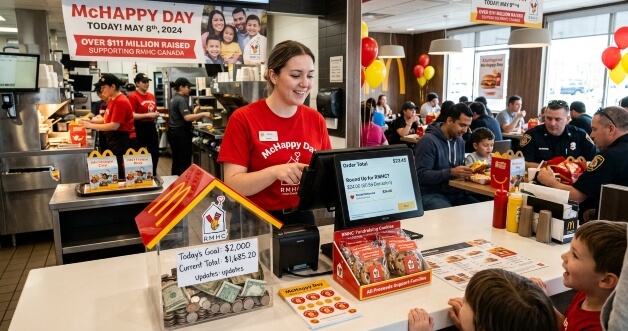
On McHappy Day, a portion of every food and drink sale goes to Ronald McDonald House Charities and local children’s charities. The 2025 day raised a record $11.3 million; McHappy Day has raised more than $111 million all-time. Year-round, McDonald’s adds Round Up at the till, RMHC cookies, and Happy Meal donations.
The “buy one, give one” model and its legacy
The purest give-back model was buy one, give one – and Canada’s best-known example, Mealshare, ran it for a decade. From 2013 to 2023, ordering a Mealshare-marked item at a partner restaurant triggered a donated meal for a youth in need, at no extra cost to the diner. Mealshare closed in 2023, but the model survives: in Calgary, BB4CK carries it forward as Feeding Futures, keeping restaurants in the loop of feeding local kids.
How to take part
Almost none of these cost you anything beyond what you were already spending. The trick is timing and a quick “yes” at the till.
- Mark the dates: Smile Cookie (late April/May), McHappy Day (spring), Burgers to Beat MS (August).
- Say yes to Round Up – cents add up fast across millions of orders.
- Buy the marked item – the cookie, the Teen Burger, the logo dish is the donation trigger.
- Check where it goes locally – many campaigns let the local restaurant pick the charity, so dollars often stay in your community.
How to know a give-back claim is real
“Proceeds to charity” can mean a lot or a little, so check three things.
- What share is donated? “100% of proceeds” is very different from “a portion of sales.”
- Who is the named charity? A real campaign names a registered charity you can look up in the CRA’s List of Charities.
- Is there a public total? Established campaigns report what they raised each year; vague claims with no numbers are a red flag.
FAQ
Among single campaigns, Tim Hortons’ Smile Cookie is the largest, raising $22.6 million in 2025 alone and over $151 million since 1996.
Usually not. Cause-day and 100%-of-proceeds items cost the regular price; round-up adds only the cents needed to reach the next dollar, and only if you agree.
It varies: MS Canada (A&W), local charities and Tims Camps (Smile Cookie), and Ronald McDonald House Charities plus local kids’ charities (McHappy Day).
No. Mealshare closed in 2023, but its buy-one-give-one model continues locally through BB4CK’s Feeding Futures in Calgary.
Watch for national campaign dates, check each chain’s site for participating locations, and look for local independents running pay-it-forward or percentage-of-sales nights.
About this page: this is an independent informational guide. We are not affiliated with the restaurants or charities named and do not collect donations on their behalf. Dates, amounts, and terms change each year – confirm current details on the official site before taking part.